Should You Change Your HVAC Filter After Wildfire Smoke or Santa Ana Winds?
Southern California homeowners are familiar with dry weather, Santa Ana winds and periods when wildfire smoke or airborne dust affects outdoor air quality.
Even when your windows and doors are closed, some outdoor particles can still make their way inside.
Your heating and air-conditioning system may then circulate indoor air through the HVAC filter repeatedly.
That raises an important question:
Should you replace your HVAC filter after a smoky or extremely dusty weather event?
In many cases, checking the filter is a very good idea.
Your HVAC Filter Has an Important Job
A standard HVAC filter does more than keep dust off the equipment.
It captures airborne particles as air moves through the return side of your heating and cooling system.
Depending on the filter and HVAC equipment, filtration can help reduce particles circulating through the home.
During periods of unusually dusty or smoky air, a filter may collect debris more quickly than it would under normal conditions.
That means a replacement schedule that normally works for your home may need to change temporarily.
Do Not Rely Only on the Calendar
You may have heard recommendations to change an HVAC filter every 30, 60 or 90 days.
Those intervals can be useful reminders, but the actual condition of the filter matters more than a fixed number of days.
Filter life can vary based on:
- Wildfire smoke
- Dusty or windy weather
- Pets
- Home construction or remodeling
- Number of occupants
- How often the HVAC system operates
- Filter size and design
- Indoor air-quality conditions
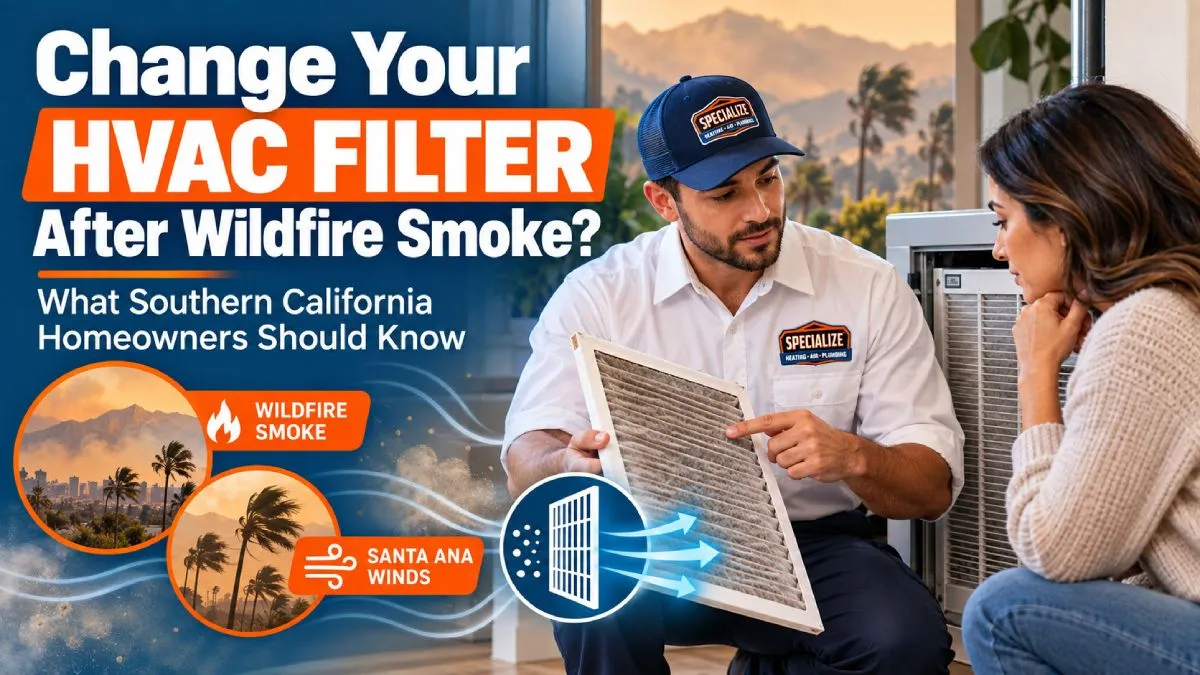
After a significant smoke or dust event, remove the filter and inspect it.
If it appears heavily loaded with dirt or debris, replacement may be appropriate even if it has not reached its usual replacement date.
What Is MERV?
MERV stands for Minimum Efficiency Reporting Value.
It is a rating used to describe how effectively an air filter captures particles of different sizes.
Higher-efficiency filters can capture smaller particles than many basic filters.
During smoke events, homeowners may hear recommendations about MERV 13 filtration.
However, this does not mean every residential HVAC system should automatically receive the highest-rated filter available.
Your HVAC System Has to Handle the Filter
A more restrictive filter can affect airflow if the HVAC equipment, return-air system or filter cabinet was not designed for it.
Reduced airflow can affect comfort and system performance.
That is why filter efficiency and HVAC compatibility need to be considered together.
If you want to upgrade filtration, an HVAC technician can evaluate the system and help determine the highest-efficiency filter that the equipment can appropriately accommodate.
What Else Can You Do During Smoky Conditions?
When outdoor air quality is poor, homeowners can take several steps to help reduce the amount of outdoor smoke entering the home.
Depending on the type of HVAC system, those steps may include:
- Keeping windows and exterior doors closed
- Operating the HVAC system in recirculation mode when appropriate
- Inspecting HVAC filters more frequently
- Using properly sized portable air cleaners
- Reducing activities that generate additional indoor particles
- Monitoring local air-quality information
If your HVAC system has an outdoor-air intake, understanding how it operates can also be helpful during a smoke event.
Not every residential system is configured the same way, so ask an HVAC professional if you are unsure.
What If the House Still Smells Smoky?
Replacing a dirty HVAC filter may help, but it does not guarantee that every smoke odor will disappear.
Smoke particles and odors can enter through doors, windows, building gaps and ventilation systems and may settle onto surfaces throughout the home.
If an odor remains, consider whether additional cleaning or air-filtration measures may be appropriate.
Persistent HVAC-related odors can also be evaluated professionally to determine whether the source is within the system.
Do You Need Your Air Ducts Cleaned After Every Smoke Event?
Not automatically.
Seeing smoke outside does not necessarily mean the home’s entire duct system requires cleaning.
The condition of the system should be evaluated before assuming a major service is necessary.
Start with practical steps such as inspecting the HVAC filter and assessing whether you have noticeable dust, odors or indoor-air-quality concerns.
An HVAC professional can help determine whether there is evidence of a problem requiring additional service.
Think About Filtration Before the Next Smoke Event
The best time to think about indoor-air filtration is not necessarily when the sky already looks smoky.
Knowing your correct filter size, understanding which filtration level your HVAC equipment can handle and keeping replacement filters available can make it easier to respond when air quality changes.
Concerned About Your HVAC Filter or Indoor Air Quality?
Specialize Home Services provides heating and air-conditioning inspection, maintenance and indoor comfort services throughout Southern California.
If you are unsure whether your HVAC filter is appropriate for your system or are concerned about airflow, filtration or system performance, our technicians can inspect your equipment and recommend practical options for your home.
